
The Cost of Fragmentation
Enterprises today operate across multiple systems that were never designed to function as one. As sales, service, marketing, and digital teams scale independently, fragmented data and disconnected workflows slow execution and decision-making.
Customer expectations continue to increase. Organizations are expected to deliver consistent, real-time experiences across every interaction, increasing pressure on already complex operating models.
These challenges have pushed enterprises to rethink how customer platforms support scale and execution. Salesforce’s long-standing leadership reflects this shift. IDC has recognized Salesforce as the global CRM leader for over a decade (Source: Salesforce).
This blog explores how Salesforce evolved beyond traditional CRM into the operational core of the AI-powered enterprise, and how capabilities like Einstein and Agentforce enable intelligent execution at scale.
CRM’s Breaking Point
Traditional CRM systems were designed primarily as systems of record, focused on capturing customer data within individual functions. This architecture limited how workflows and automation could operate across sales, service, marketing, and digital channels.
While customer data was shared, execution remained fragmented. Teams ran parallel processes, automation was confined to isolated use cases, and insights rarely translated into coordinated action across the enterprise.
Salesforce addressed these limitations by shifting from an application-centric CRM model to a platform-based architecture built on a shared data foundation. This enabled workflows, automation, and intelligence to operate across functions, supporting end-to-end execution across the customer lifecycle rather than within disconnected systems.
Fixing fragmented execution required more than improving CRM features. It demanded a unified platform designed to operate across the entire enterprise.
Salesforce’s Unified Platform Model
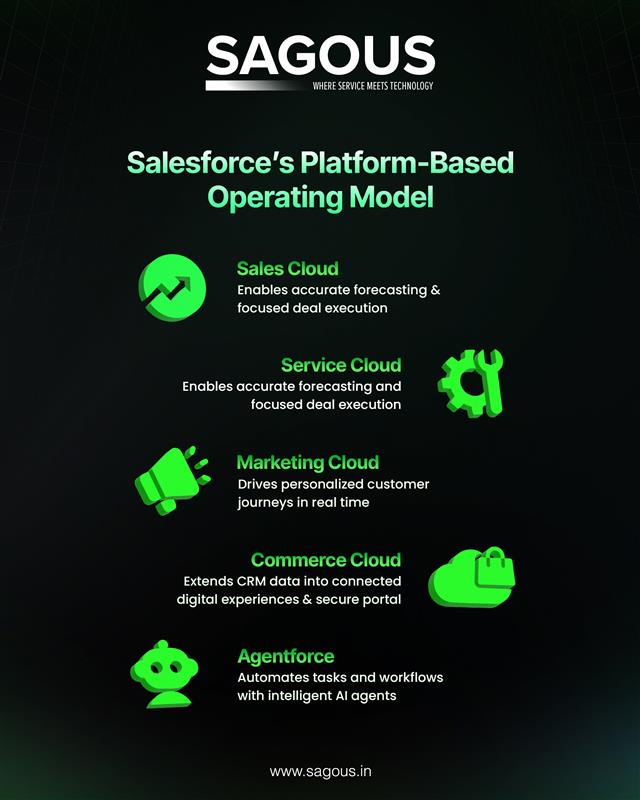
At the core of Salesforce is a shared data model that connects every business function.
- Sales Cloud
Enables accurate forecasting, pipeline management, and focused deal execution, helping sales teams close opportunities faster and more predictably. - Service Cloud
Delivers faster, consistent support across every channel, including phone, chat, email, and social, ensuring customers get reliable service anytime. - Marketing Cloud
Drives personalized customer journeys in real time with automation, AI-powered recommendations, and cross-channel campaign management. - Commerce Cloud
Extend CRM data into connected digital buying experiences and secure portals, enabling seamless e-commerce, self-service, and personalized engagement. - Agentforce
Automates repetitive tasks and workflows with intelligent AI agents, enhancing productivity, accelerating decision-making, and supporting smarter operations across Salesforce.
Together, these components form a single, connected operating model. At enterprise scale, unification only works when security, governance, and compliance are embedded by design.
Designed for Enterprise Complexity
Salesforce is built for enterprise environments where scale, security, and governance are critical. As customer data becomes centralized, fine-grained access controls, auditability, and policy enforcement ensure information remains protected across teams and regions.
Enterprise-grade security, compliance, and reliability are embedded by design, enabling Salesforce to support global operations, regulatory requirements, and long-term growth without introducing operational risk or performance bottlenecks.
Einstein: AI Inside Everyday Work
As data volumes grew, enterprises needed intelligence, not just reports. Salesforce addressed this by embedding AI directly into workflows through Einstein.
Einstein helps teams:
- Identify high-conversion leads and at-risk deals
- Improve forecasting accuracy
- Generate AI-driven summaries, emails, and insights
- Receive context-aware next-best-action recommendations
Salesforce reports that organizations using Einstein-powered capabilities improve forecasting accuracy, enabling more proactive and confident decision-making.
Enterprise Proof Point: Einstein in Action at Scale
Global enterprises are already applying embedded AI to move faster from insight to execution. Schneider Electric, a multinational leader in energy management and automation, is one such example.
By embedding Einstein-powered intelligence into Salesforce workflows, Schneider Electric enabled sales and service teams to prioritize opportunities more accurately and improve forecasting confidence across regions. Rather than relying on static reports, teams acted on real-time, AI-driven insights directly within Salesforce, improving responsiveness and operational consistency across global operations.
Source: Schneider Electric unlocks sales opportunities with Salesforce
Understanding what was happening was only the first step. Real-time action required more than intelligence alone.
Agentforce: AI That Acts, Not Just Advises
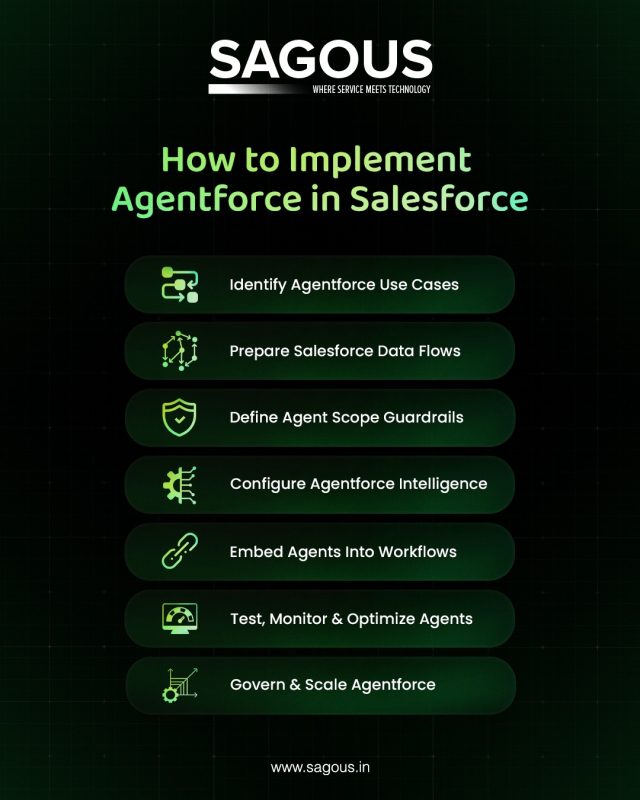
As enterprises move from AI experimentation to real-world execution, insight alone is no longer enough. Organizations need systems that can act across workflows, not just recommend next steps. This is where Agentforce in Salesforce plays a defining role.
Agentforce introduces autonomous AI agents designed to execute business tasks across sales, service, and enterprise operations. Unlike traditional bots or rule-based automation, these agents understand context, adapt to changing conditions, and operate across Salesforce workflows.
One of the most immediate applications is customer service automation. With Agentforce integrated into Service Cloud, AI agents can triage cases, resolve common requests, and escalate complex issues to human agents when needed, improving response times while maintaining human oversight.
Beyond service, AI agents for sales and support automate follow-ups and guide deal progression. In IT and enterprise workflows, Agentforce supports approvals, orchestration, and cross-system coordination.
The real value of Agentforce lies in its ability to turn intelligence into execution, helping enterprises scale with speed, consistency, and control. Even as execution becomes more autonomous, accountability and judgment remain human responsibilities.
Humans in the Loop
While AI agents increase speed and efficiency, Salesforce is built on a clear principle: AI augments people and does not replace them. Human judgment, governance, and domain expertise remain essential.
As Salesforce platforms become more intelligent, enterprises are seeing growing demand for Specialized Salesforce and AI-focused roles, including:
- Salesforce Solution Architect (Enterprise CRM & AI)
- Salesforce AI / Agentforce Specialist
- Service Cloud Architect / Automation Lead
- Salesforce Platform & Integration Engineer
- Salesforce Data & Analytics Consultant
- Salesforce Security & Governance Specialist
According to IDC, the Salesforce ecosystem is expected to continue generating significant employment opportunities worldwide, spanning technical, analytical, and business roles.
Where Data Becomes Execution
Modern enterprises don’t fail due to a lack of tools. They struggle with coordination, speed, and execution.
Salesforce addresses this by unifying data and workflows, embedding intelligence through Einstein, and enabling autonomous execution through Agentforce. Together, these capabilities allow insight to move directly into action across the customer lifecycle.
The result is an operating model where decisions, automation, and execution happen in context, at enterprise scale.
Conclusion: Salesforce as the Enterprise Core
Salesforce has evolved far beyond traditional CRM. It now serves as the operational core that connects data, teams, and intelligence into a single enterprise model.
By combining embedded AI through Einstein with intelligent execution through Agentforce, Salesforce enables organizations to move from reactive workflows to scalable, intelligent operations.
This is what positions Salesforce as the operational center of the modern enterprise.
Operationalize Salesforce with Sagous
Sagous India supports enterprises with Salesforce platform delivery, Service Cloud optimization, AI-driven automation, enterprise workflow integration, and strategic staffing for Salesforce and AI initiatives, helping teams turn intelligence into execution.
Ready to operationalize Salesforce at scale? Let’s talk