Artificial intelligence is rapidly reshaping the software development landscape by introducing tools and technologies that enhance productivity, accuracy, and innovation. From writing code to identifying security vulnerabilities, AI is becoming an essential part of modern development workflows.
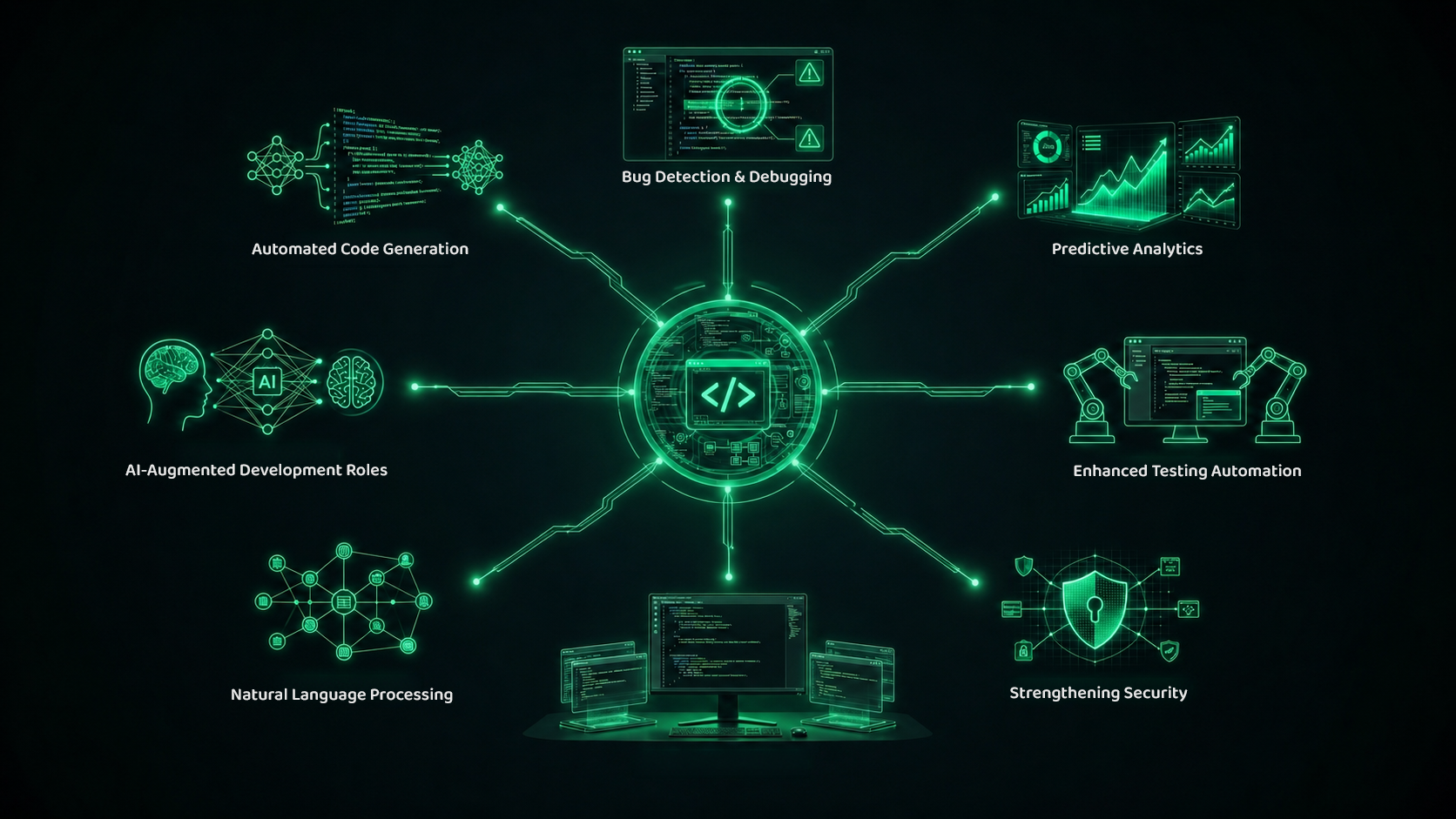
Rather than replacing developers, AI is enabling a new model of AI-assisted development, where human expertise and machine intelligence work together to design, build, test, and maintain software systems more efficiently. Below are seven powerful ways AI is transforming modern software development.
1. Automated Code Generation
AI-powered coding assistants such as GitHub Copilot, Amazon CodeWhisperer, Claude, and Gemini-based coding tools from Google can generate code snippets based on natural language prompts or existing code patterns. Developers can describe what they want to build, and AI tools can suggest functions, complete lines of code, or even generate entire code blocks.
This significantly reduces time spent on repetitive programming tasks, allowing developers to focus more on solving complex problems and designing scalable systems.
GitHub’s research with Accenture found that developers using Copilot completed tasks up to 55% faster, along with significant improvements in developer satisfaction and workflow efficiency.
Source: Quantifying GitHub Copilot’s impact with Accenture
2. Bug Detection and Debugging
Machine learning algorithms can analyze large volumes of code to detect bugs, inefficiencies, and potential errors much faster than traditional manual reviews. AI-powered debugging tools help identify the root causes of issues and recommend possible fixes. By detecting problems early in the development lifecycle, teams can improve software reliability and reduce costly post-release fixes.
Microsoft Visual Studio’s integration with GitHub Copilot enables developers to debug more efficiently by explaining exceptions, identifying root causes, and suggesting fixes using repository-aware context.
Source: Debug with GitHub Copilot
3. Predictive Analytics for Project Management
AI can analyze historical project data to forecast timelines, estimate resource requirements, and identify potential project risks. By providing predictive insights, AI helps project managers make more informed decisions, allocate resources effectively, and keep development projects on track.
Global Survey 2025 highlights that organizations are leveraging AI to enhance project forecasting, improve resource planning, and proactively manage risks based on data-driven insights.
Source: McKinsey: The State of AI 2025
4. Enhanced Testing Automation
Software testing has traditionally been one of the most time-consuming stages of development. AI-driven testing tools are transforming this process by automatically generating test cases, identifying edge scenarios, and predicting where failures are most likely to occur. This enables development teams to achieve broader testing coverage while significantly reducing manual effort.
Tricentis’ AI-powered Tosca platform uses agentic and risk-based testing to automate testing processes, improve defect detection, and optimize testing efforts.
Source: Agentic Test Automation in Tosca
5. Strengthening Security in Development
Security vulnerabilities remain a major concern in modern software systems. AI-powered security tools can scan code for potential weaknesses and detect patterns associated with security risks. By integrating AI-driven security analysis into development pipelines, organizations can identify vulnerabilities earlier and reduce the risk of security breaches.
For example, Snyk enables teams to detect and fix vulnerabilities in code and dependencies in real time by integrating directly into CI/CD workflows.
Source: Snyk Docs: CI/CD Integrations
6. Natural Language Processing for Documentation
Maintaining accurate documentation can be challenging, especially for large and complex codebases. AI tools using natural language processing (NLP) can generate documentation directly from code or developer inputs. This helps create clearer technical documentation, improves collaboration between teams, and ensures that project knowledge remains accessible.
For instance, GitHub Copilot enables teams to capture and share technical knowledge by transforming code logic into clear, understandable documentation.
Source: Generate Documentation Using GitHub Copilot
7. AI-Augmented Development Roles
As AI becomes more integrated into development workflows, the role of developers is evolving. Engineers increasingly need to collaborate with AI tools, evaluate AI-generated code, and ensure outputs meet performance, reliability, and security standards.
As a result, skills such as critical thinking, system design, and AI literacy are becoming essential for modern software engineers. This transformation is also reshaping engineering teams and creating new specialized roles.
In this context, Accenture highlights how organizations are adopting AI-augmented roles, where developers focus on guiding, validating, and refining AI-generated outputs.
Source: Accenture: Workers in the Age of Generative AI
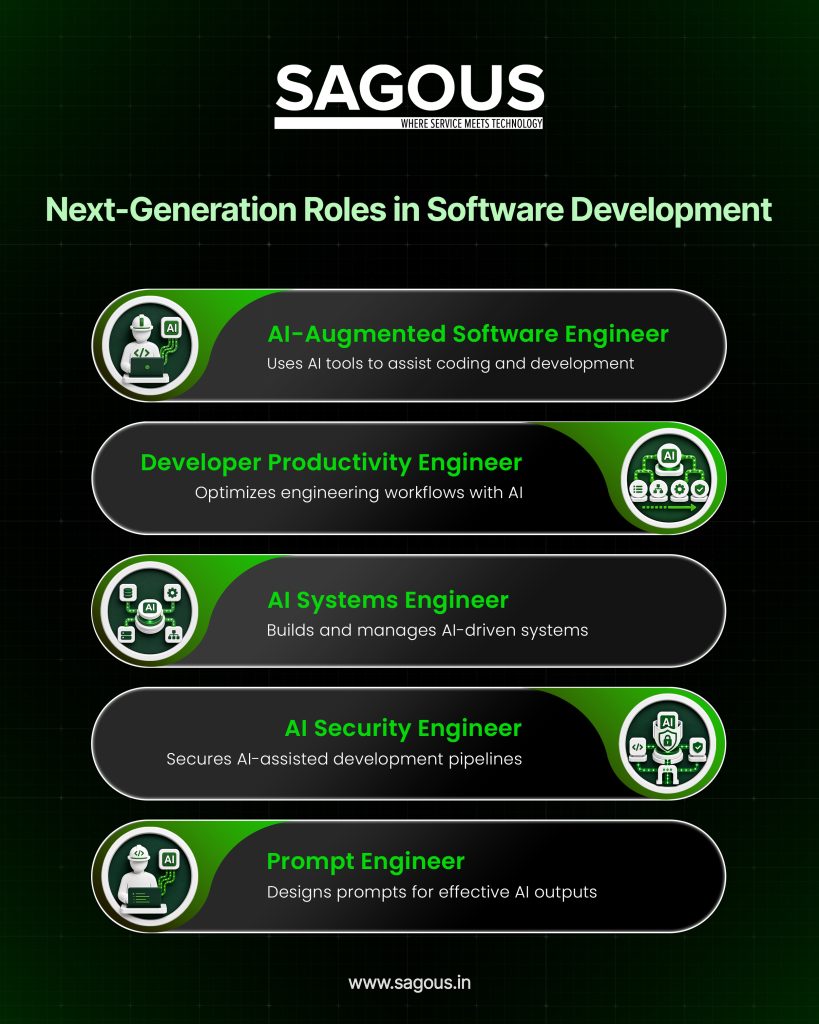
Emerging Roles in AI-Assisted Software Development
As artificial intelligence becomes increasingly integrated into development workflows, new roles are beginning to emerge within engineering teams. These roles reflect how developers are now expected to work alongside intelligent tools and validate AI-generated outputs.
Examples of emerging roles include:
- AI-Augmented Software Engineer – Developers who use AI-powered tools to accelerate coding, debugging, testing, and documentation.
- Developer Productivity Engineer – Professionals focused on integrating AI tools into development environments to improve engineering efficiency.
- AI Systems Engineer – Engineers responsible for designing and maintaining systems that leverage machine learning capabilities.
- AI Security Engineer – Specialists who ensure AI-assisted development processes meet security and compliance standards.
- Prompt Engineer – Experts who design effective prompts to guide AI tools in generating accurate and useful outputs.
These roles highlight a broader shift in software engineering, where developers combine traditional programming expertise with the ability to effectively collaborate with AI technologies.
The Future of Software Development
Artificial intelligence is not replacing developers. Instead, it is transforming how software is created. By automating repetitive tasks and supporting complex analysis, AI allows engineers to focus more on creativity, architecture, and complex problem-solving.
As organizations adopt AI-assisted development practices, access to the right technical expertise becomes increasingly important.
Supporting Modern Software Development
AI is changing the way software is developed, tested, and maintained. Organizations need the right technical expertise to keep pace with this shift. SAGOUS supports businesses in developing secure and reliable digital solutions while also providing skilled technology professionals who help teams build and maintain modern software systems.
Let’s explore how SAGOUS can support your software development goals.