As AI systems become more advanced and deeply built into enterprise environments, secure integration between models and external tools is essential. Model Context Protocol (MCP) has become a widely used standard for this kind of integration. Like any powerful framework, it brings its own security challenges. This article provides an overview of MCP’s architecture, identifies the main security risks tied to its deployment, and details actionable measures that security and engineering teams can use to reduce potential exposure.
Understanding Model Context Protocol
Model Context Protocol is an open specification designed to standardize how Large Language Models interact with tools, APIs, and data sources. Instead of building custom connectors or
one-off integrations, MCP provides a structured and reusable framework for connecting AI models to external systems.
Key Capabilities of MCP
- A standardized API framework for sharing context between LLMs and applications
- Defined mechanisms for invoking tools and accessing external data sources
- A structured protocol for organizing and executing AI-generated requests
By abstracting the integration layer, MCP allows teams to focus on business logic while maintaining the flexibility to switch LLM providers or tools when needed.
Architectural Components of MCP
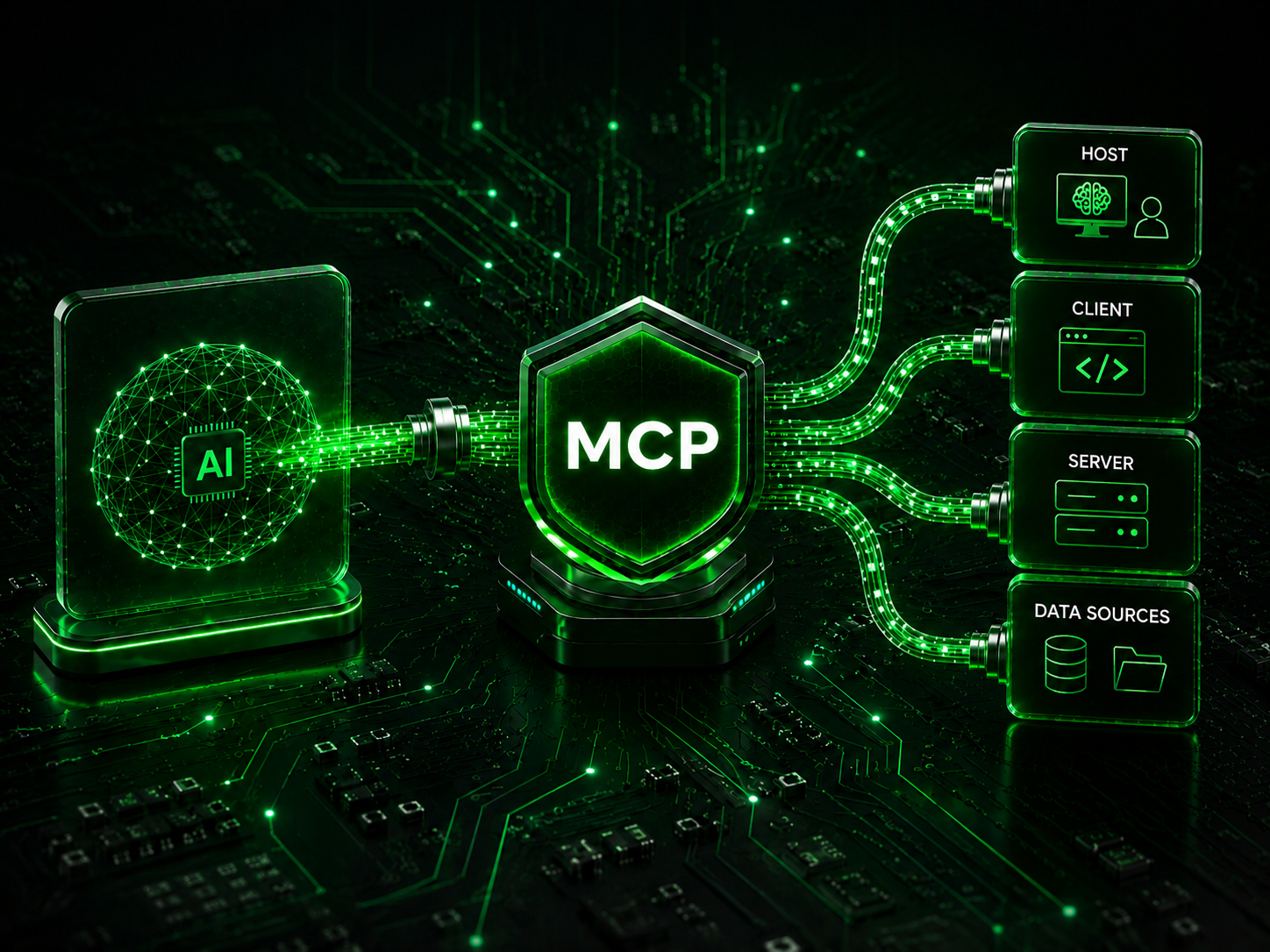
MCP follows a client-server architecture that enables communication between AI systems and external resources.
- MCP Host: The Large Language Model (LLM) that initiates requests for actions or data
- MCP Client: The intermediary layer that routes the model’s requests to the appropriate server
- MCP Server: The service layer that provides access to tools, APIs, databases, or files
- Data Sources: The underlying systems or external APIs accessed through the MCP server
This modular structure enables interoperability but introduces multiple trust boundaries. Each boundary must be carefully secured.
The Role of MCP in Autonomous AI Systems
The transition from simple question answering to autonomous agents capable of executing complex workflows has made MCP a critical enabler. These agentic AI models require seamless access to external tools, databases, and APIs to execute multi-step tasks. For example, an AI research assistant may query scientific databases, schedule meetings, and draft reports through connected services. Without a structured protocol like MCP, these integrations become fragile and more susceptible to misconfiguration and security vulnerabilities. By adopting MCP, organizations can provide agentic AI systems with reliable and auditable access to enterprise toolchains. This forms a critical foundation for building secure and trustworthy AI-driven automation.
Key Security Exposure Areas in MCP Deployments
The flexibility and extensibility of MCP introduce new security risks if standard controls are not properly enforced. Many of these issues stem from how authentication is configured, how permissions are granted, and how prompt content is interpreted by AI systems.
1. Authentication Weaknesses in MCP Environments
Limitations of Early Authentication Approaches
Earlier MCP implementations required developers to implement their own OAuth 2.0 authorization servers. This resulted in inconsistent authentication methods and, in some cases, insecure token validation practices. The absence of centralized identity providers often led to misconfigurations in authorization logic.
Impact of Authentication Failures
Weak authentication controls can lead to OAuth token theft, allowing attackers to impersonate MCP servers. Broken access controls may expose sensitive enterprise systems. Insecure storage of tokens increases the risk of credential compromise and unauthorized access.
Strengthening Identity and Access Controls
To mitigate these risks, organizations should adopt updated MCP specifications that support delegated authentication. Integration with centralized identity providers is essential. Token storage must follow encryption best practices, and authorization logic should be rigorously validated. API management solutions can further strengthen monitoring and enforcement.
2. Overprivileged Access Configurations
The Risk of Broad System Permissions
MCP servers are frequently given extensive access to backend systems to support operational flexibility in AI-driven workflows. However, this violates the principle of least privilege and creates high-impact attack paths.
Business and Data Impact
Excessive permissions may result in data exfiltration from unrelated systems, unauthorized modifications to sensitive resources, and exposure of personally identifiable information.
Enforcing Least Privilege
Permissions should be scoped to specific use cases or endpoints. Role-based or attribute-based access controls should be implemented to enforce granularity. Regular audits of MCP server access patterns are necessary to restrict unnecessary capabilities.
3. Prompt-Based Exploitation and Tool Manipulation
Understanding Indirect Prompt Injection
Indirect prompt injection, also known as cross-domain prompt injection, occurs when malicious instructions are embedded in external content such as tool descriptions or metadata. When processed by the model, these instructions may be interpreted as valid commands, resulting in unintended behavior.
Metadata Manipulation and Tool Poisoning
Tool poisoning is a related threat in which the metadata of MCP tools is manipulated. Because LLMs rely on this metadata to determine which tools to invoke, altered descriptions can trigger unauthorized actions.
Resulting Threat Scenarios
These attacks can lead to silent data exfiltration, model manipulation without user visibility, and execution of unapproved tool actions, especially in environments that allow dynamic tool registration.
Defensive Safeguards
Organizations should sanitize inputs and tool metadata, validate metadata during tool registration, and secure the MCP supply chain to prevent tampering with tools or server logic.
4. Supply Chain and Third-Party Dependency Risk
Expanding Supply Chain Exposure
In MCP environments, the supply chain includes external MCP servers, tools, foundation models, context providers, APIs, and infrastructure pipelines. Each dependency introduces a trust boundary and expands the potential attack surface.
Business and Security Impact
Supply chain vulnerabilities can enable unauthorized access, malicious tool execution, or data exposure. Because MCP connects multiple enterprise systems, compromised dependencies can propagate risk across connected workflows.
Strengthening Supply Chain Integrity
Organizations should verify tool sources, enforce code provenance, scan dependencies for vulnerabilities, and adopt Software Bills of Materials (SBOMs). Regular penetration testing and threat modeling further reduce supply chain risk.
Prompt Defense Mechanisms for MCP
Prompt Shields are an emerging defense mechanism designed to detect and block prompt-based attacks.
Core Protective Capabilities include:
- Detection and filtering using NLP and machine learning techniques
- Identification of untrusted inputs to reduce model misinterpretation
- Clear delimiters and structured data marking to define input boundaries
- Continuous updates to address evolving threats
Prompt Shields reinforce model integrity by preventing malicious or unintended instructions from influencing model behavior.
Shared Accountability in MCP Security
Protecting MCP environments demands close collaboration among development, security, and operations functions. Developers are responsible for implementing secure client-server communication, properly handling tokens, and sanitizing inputs. Security teams define access policies, monitor system health, and conduct threat modeling. Operations teams ensure infrastructure resilience and logging visibility. A DevSecOps approach ensures that security is embedded into the MCP service lifecycle. Regular cross-functional reviews can uncover hidden risks and strengthen accountability across teams.
Securing MCP for Enterprise AI Adoption
MCP-specific controls must be backed by strong foundational security practices, making baseline security hygiene essential. Key measures include secure coding, infrastructure hardening with multi-factor authentication and patch management, end-to-end encryption, centralized logging and monitoring through a SIEM platform, and Zero Trust access enforcement.
As MCP enables autonomous AI systems to interact with enterprise tools and services, it becomes a critical security boundary. Organizations should assess their MCP attack surface, enforce granular access controls, and combine AI-specific safeguards with established enterprise security controls to reduce risk.
MCP remains an evolving standard, requiring careful implementation and close collaboration between engineering and security teams. A structured security approach enables organizations to harness AI-driven automation while protecting critical systems and maintaining operational resilience.
Enable Secure MCP Integration with SAGOUS
AI is shifting from trial runs to core business operations, and security needs to be built into the foundation, not added on later.
Partner with SAGOUS to protect your MCP-enabled AI workflows, reduce emerging risks, and create resilient architectures that support safe, scalable AI adoption across your enterprise.
Is your MCP foundation ready to support secure, scalable AI growth? Let’s talk.